Identify the laboratory
The report identifies Eurofins as the laboratory that analyzed the submitted sample.

BLACK SEED OIL LAB TESTING
Independent lab testing gives you something marketing language cannot: a documented result from a tested sample.
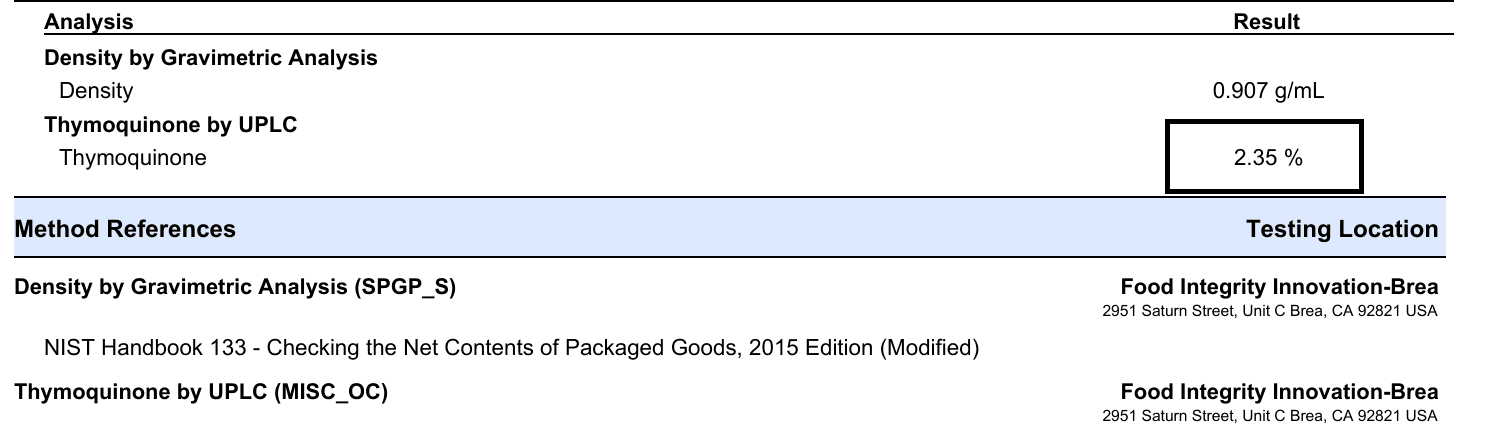
A Hadith Organics black seed oil sample was analyzed by Eurofins. The tested sample measured 2.35% thymoquinone using UPLC. We publish the result and the report because transparency matters.
 Open full Certificate of Analysis →
THIRD-PARTY TESTED BLACK SEED OIL
“Third-party tested” should mean more than putting a badge on a bottle. It should point to a real laboratory, a real method and a report tied to a specific sample.
Hadith Organics uses the lab result as one piece of product transparency. The report documents measurements from the sample that was submitted for analysis. It does not automatically describe every future bottle or replace the need to evaluate sourcing, processing, freshness, storage and purity.
BLACK SEED OIL COA
A COA is most useful when you can connect the headline number back to the laboratory, the analytical method and the report itself.
The report identifies Eurofins as the laboratory that analyzed the submitted sample.
The reported constituent is thymoquinone, often abbreviated as TQ.
The thymoquinone result was measured using UPLC, an analytical separation method.
The tested sample measured 2.35% TQ. That is a documented data point, not a universal score for oil quality.

THYMOQUINONE TESTING
Thymoquinone is a naturally occurring constituent of Nigella sativa. Measuring it can provide useful information about a tested black seed oil sample.
TQ is one measurable characteristic, but a finished oil should not be judged by one percentage alone. Ingredient identity, sourcing, extraction, freshness, handling, storage and purity also matter.
WHAT LAB TESTING CAN TELL YOU
BEYOND A SINGLE NUMBER
A laboratory result is valuable, but quality starts before the sample ever reaches the lab.
The ingredient should be clearly identified as Nigella sativa, rather than relying only on a common name.
Processing choices affect how the oil is presented and should be disclosed clearly.
Oils change over time, so production, storage and handling matter alongside a laboratory result.
Heat, light and prolonged air exposure can work against the quality of an oil after production.
A simple ingredient list makes it easier to understand exactly what is in the bottle.
Clear product information, testing details and accessible reports let customers evaluate claims for themselves.
COMMON QUESTIONS
A Certificate of Analysis is a laboratory report that records the tests performed on a submitted sample and the results reported by the laboratory.
A Hadith Organics black seed oil sample was independently analyzed by Eurofins. The final report is dated May 28, 2025 and carries report number 4940074-0.
It means the tested sample measured 2.35% thymoquinone using UPLC. The result applies to the sample analyzed and should not be treated as a complete quality score for the oil.
Not necessarily. TQ is one measurable characteristic. Botanical identity, sourcing, freshness, extraction, handling, storage and purity also contribute to how a finished oil should be evaluated.
The full Hadith Organics Certificate of Analysis is available from the link on this page and can be opened directly as a PDF.
LEARN MORE
Learn about Nigella sativa, cold pressing, thymoquinone, storage and the broader quality picture.
READ THE GUIDE →PRODUCTSee Hadith Organics Black Seed Oil.View product details, ingredient information and the testing summary in one place.
VIEW BLACK SEED OIL →