
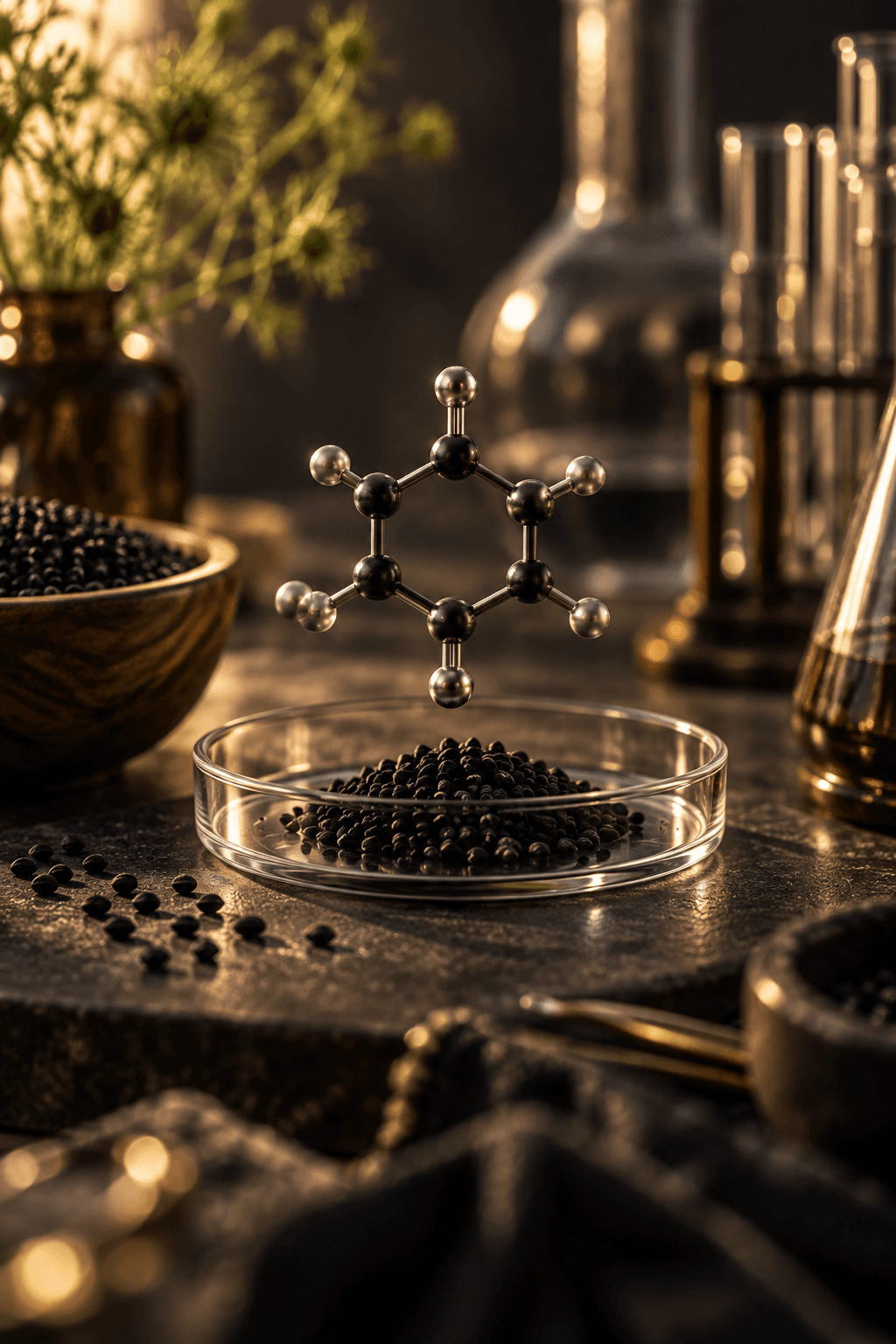
Thymoquinone, in plain language.
Thymoquinone — usually shortened to TQ — is a naturally occurring constituent associated with Nigella sativa, the botanical species used to produce black seed oil. Research literature commonly discusses TQ as one of the plant’s characteristic bioactive compounds.
That does not make TQ the same thing as black seed oil itself. Black seed oil is a complex mixture containing many constituents, while TQ is one measurable component within that broader matrix.
Why do black seed oil brands measure TQ?
Measuring TQ can provide an objective data point about a submitted oil sample. A laboratory can analyze the sample using an analytical method and report the amount detected under the conditions of that test.
It should be tied to the laboratory, method, report and sample tested rather than treated as a universal promise about every future bottle.
What does a percentage such as 2.35% mean?
Hadith Organics’ Eurofins report states that the tested sample measured 2.35% thymoquinone using UPLC. That number is useful because it is traceable to a specific report and method.
It is not a complete score for black seed oil quality. Composition can vary with raw material, processing, storage and other factors, and scientific reviews emphasize that Nigella sativa preparations are not all chemically identical.
Does higher TQ automatically mean better black seed oil?
Not automatically. A high headline number does not answer every quality question. A thoughtful evaluation should also consider botanical identity, sourcing, extraction method, freshness, handling, storage, purity and whether the brand provides enough information to verify its claims.
This is why we treat thymoquinone as one quality signal, not the definition of quality itself.