
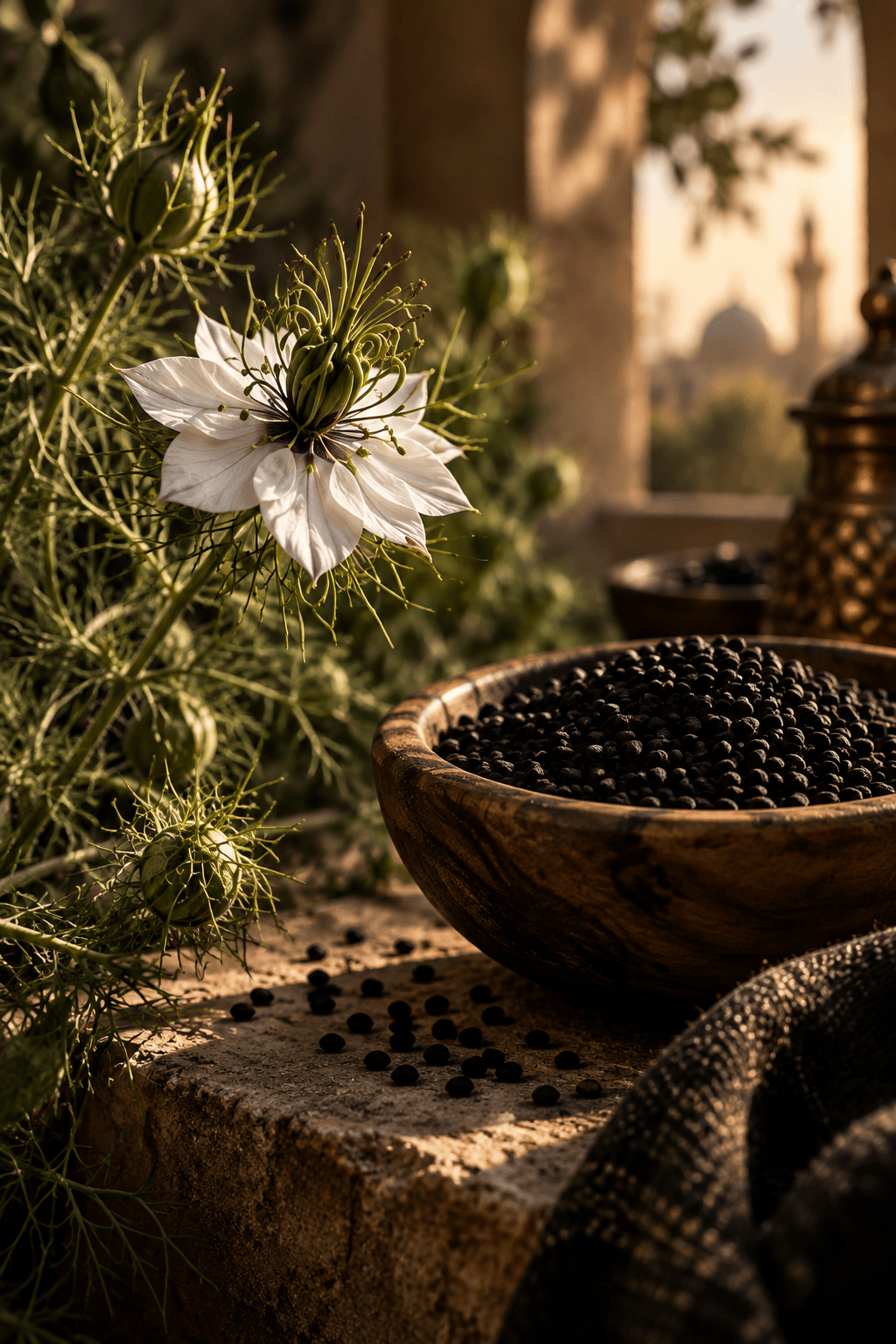
Nigella sativa is a plant species.
Nigella sativa L. is an accepted plant species in the Ranunculaceae family. Kew Science describes it as an annual plant and records its native range from Romania through western and southwestern Iran.
The plant produces dark brown to black seeds. Those seeds are the raw material used to make the fixed oil commonly sold as black seed oil.
Why is it called black seed, black cumin or black caraway?
Common names vary by language, region and market. You may see black seed, black cumin or black caraway used for products associated with Nigella sativa.
Common names can overlap with unrelated plants, which is why the botanical name is more precise than relying on a marketing name alone.
The botanical name is the clearest way to identify the plant species used to make the oil.
How does Nigella sativa become black seed oil?
Oil can be separated from the seeds using different extraction techniques. Mechanical cold pressing is one commonly studied approach, while other methods include solvent extraction and supercritical fluid extraction.
The extraction method can influence yield and the chemical profile of the finished oil, so “what plant?” and “how was it processed?” are both useful questions.
Why botanical identity matters when shopping.
A clear black seed oil label should make the species easy to identify. For Hadith Organics, the ingredient is presented as 100% Nigella sativa oil.
Botanical identity is only one part of quality, but it is a sensible place to start before evaluating extraction, freshness, storage and laboratory information.